


Brief thoughts on Islamophobia
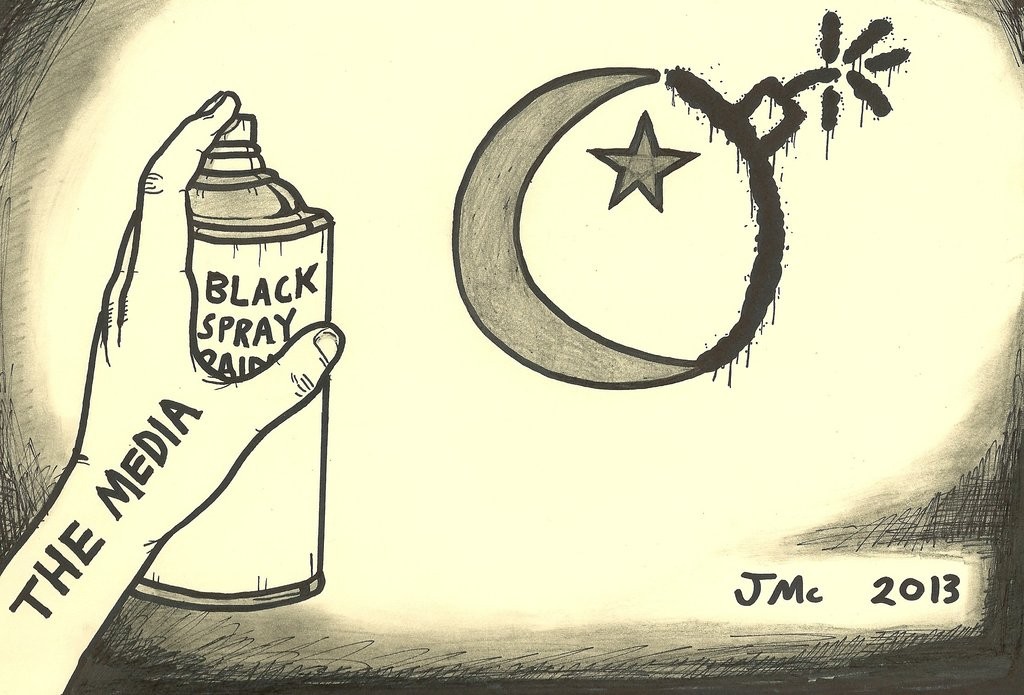
”Islamophobia”, or the irrational fear against Muslims or the religion of Islam, has powerful implications on individuals, social groups and society in general. A “Phobia”, is “an extreme or irrational fear of or aversion to something”[1]. This fear has powerful implications on how Muslims and Islam are viewed based on the underlying assumptions and hidden biases people form. These assumptions and ideas form not just an impression but the dynamic between the social world and the personal world meets in between in the space called an “Identity”.
Knowing ourselves allows us to know what we should think, feel and do in any given situation. Knowing others allows us to predict what others will think and do in such a circumstance. Charles Cooley’s “The Looking Glass Self” is a derivative of the knowledge of oneself that can be applied in our study of Islamophobia. These concepts of knowing ourselves and knowing others can be known as simply “self-awareness” or “symbolic self-awareness”. It is the ability to describe oneself through language. One particular impact of Islamophobia on the individual’s idea of “self-awareness” is the idea that if “Muslims are always defending themselves after terrorist attacks therefore Muslims are terrorists”. This ends up being a self-fulfilling prophecy, where the self-concept of the individual being “peaceful and loving” is met with the cultural impression of “terrorism and dangerous”, what translates is the breeding of more fear against Muslims and Islam.
A statement by the French Interior Minister Bernard Cazeneuve on the closure of mosques where radical discourse takes place is unsound when studies have shown that, ” Many experts and reports have shown that the mechanics of radicalisation are materialised outside of mosques and that the principal place of brainwashing and recruitment is the internet.”[2] In the same article, it shows that Islamophobia is so deeply imbedded in the self-concept of the Muslim community that there seems to be a need for Muslims to speak against terrorist attacks despite no confirmation of the perpetrator’s identity.
The fear-mongering that the media plays is a form of symbolic self-awareness whenever the footage of bombing takes place immediately after footage of Muslims. Even the very words used to describe Muslims are linked to violence and terrorism[3]. The influence of media could take on more positive views of Muslims instead of the sniper-scope narrow-vision of minority Muslims engaged in wars. The same article states that "Western media organisations must see normal Muslims in everyday life, as professionals, educators, parents, community leaders and participants," it adds.
Perhaps, there can be no greater example of how Islamophobia breeds distrust in cosmopolitan communities than the way several politicians are handling the situation. On the idea of heavier surveillance on American Muslims, Trump said the US government "is going to have to look at a lot of things very carefully" and "look at the mosques"[4]. Donald Trump, the Republican front-runner and another Republican candidate are undoubtedly feeding unhealthy anti-Muslim narratives as stated, “McCaw said that American Muslims have been targeted by government surveillance programmes and intelligence agencies for years”[5].
Charles Cooley’s theory of the “Looking Glass Self” tells us that socialization and our sense of self occurs through a mirroring effect. The agents of socialization like the media, our significant partners, family, religious affiliations, schooling and social groups have a mirroring effect on the way we view the world. This “Weltanschauung” or world view is central to not just the way Muslims sees themselves but also how the world views Muslims. One interesting aspect is how Muslim children’s self-concept and self-esteem is impacted through such heavy propagation of the “terrorizing Muslims” by the “generalized other” theory and the media in general. Perhaps one way of responding for the Muslims would be to build on their foundations of self-efficacy. What Muslims can or cannot do and their beliefs as to whether they can change societal perception of themselves is the new narrative that needs to be told. If the Muslim community is to ever impact a change on the heavy Islamophobia imposed on them, they need to get out of this cycle of learned helplessness and downward spiral of repetitive false narratives.
[1] http://www.oxforddictionaries.com/definition/english/phobia
[2] http://www.aljazeera.com/indepth/opinion/2015/11/stigmatising-muslims-france-harm-151119141902298.html
[3] http://www.theguardian.com/media/2005/nov/14/pressandpublishing.raceintheuk
[4] http://www.aljazeera.com/news/2015/11/rights-group-slam-islamophobia-candidates-151120140330904.html%20
[5] http://www.aljazeera.com/news/2015/11/rights-group-slam-islamophobia-candidates-151120140330904.html%20
Comments